TL;DR: The signals that best predict buying intent are recent, repeated, and commercially meaningful actions that show a company is actively researching, changing, or preparing to solve a problem. The strongest buying intent signals include pricing page visits, demo requests, competitor research, hiring activity, funding announcements, technology changes, leadership moves, and repeated engagement from target accounts.
What Are Buying Intent Signals?
Buying intent signals are behaviours, events, or data points that suggest a person or company may be preparing to purchase a product or service. In B2B sales, these signals help teams identify which accounts are most likely to enter a buying cycle.
A good intent signal answers a simple question: why might this company need a solution now? The best signals are not random activity. They connect to a clear business problem, budget trigger, operational change, or decision-making moment.
Which Signals Best Predict Buying Intent?
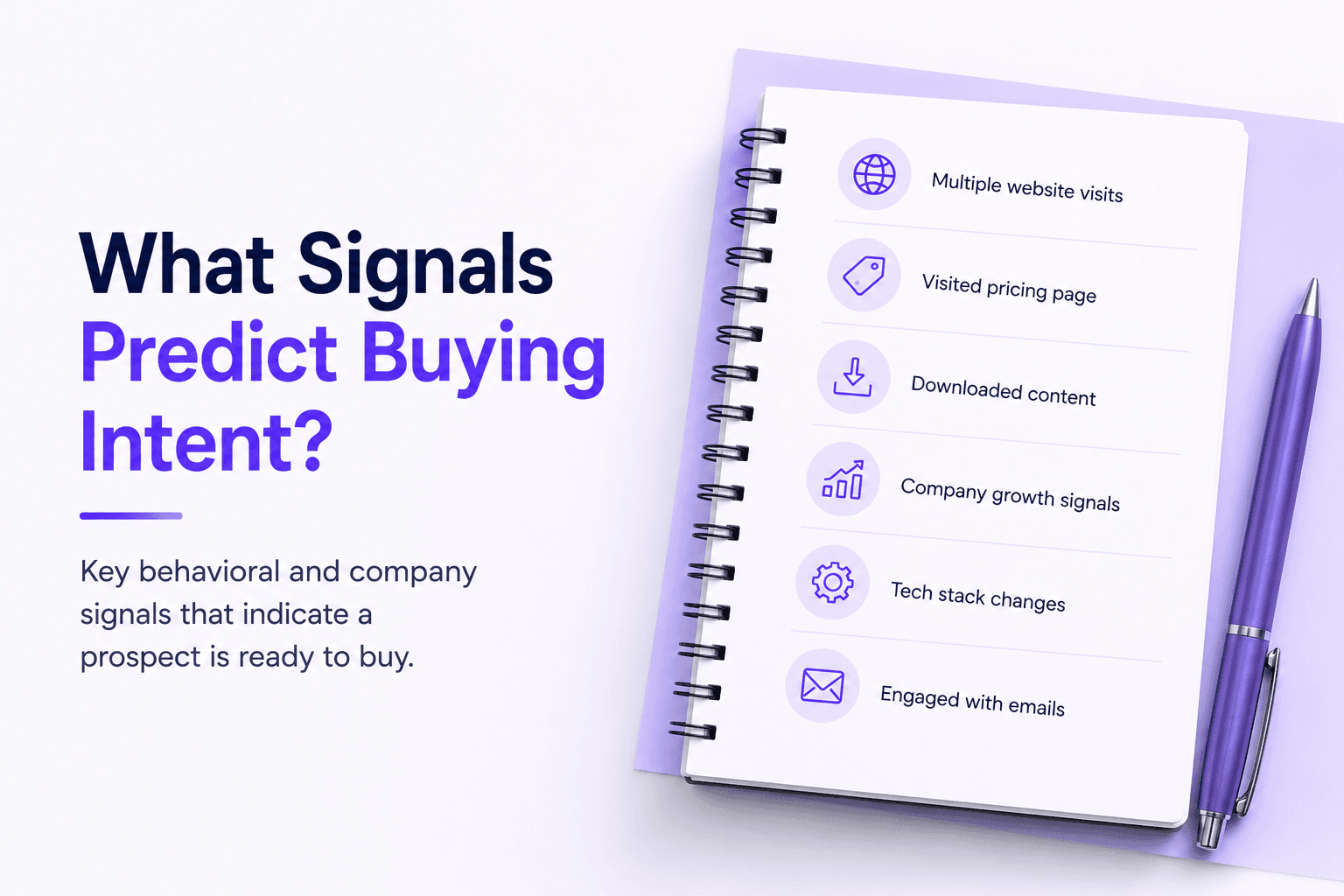
The most predictive buying intent signals usually fall into two categories: behavioural signals and trigger-event signals. Behavioural signals show what a prospect is researching. Trigger-event signals show what is changing inside the company.
Buying Intent Signal | Intent Level | What It May Predict |
|---|---|---|
Demo request | Very high | Active vendor evaluation |
Pricing page visit | High | Budget or cost comparison |
Competitor comparison research | High | Solution-aware buying stage |
Multiple product page visits | Medium to high | Problem or category research |
Funding announcement | Medium to high | New budget and growth plans |
Hiring activity | Medium | Operational expansion or capability gaps |
New executive hire | Medium to high | Vendor review or strategic change |
Technology adoption | Medium to high | Integration, replacement, or upgrade need |
Why Are First-Party Signals So Valuable?
First-party signals are valuable because they come directly from your own channels. These include website visits, form fills, product interactions, email engagement, demo requests, content downloads, and webinar attendance.
A target account visiting your pricing page twice in one week is usually a stronger signal than a broad third-party topic surge. First-party behaviour shows direct engagement with your brand, product, or solution category.
The strongest first-party signals include:
Demo or consultation requests
Pricing page visits
Product comparison page views
Case study engagement
Integration page visits
Repeat visits from the same company
High-value content downloads
How Do Company Changes Predict Buying Intent?
Company changes often create new buying needs. When a business raises funding, hires a new leader, expands into a new market, or grows a department, existing systems may no longer be enough.
For example, a company hiring ten sales representatives may need CRM improvements, sales engagement tools, onboarding support, call coaching, or better lead data. A company that appoints a new CFO may soon review finance systems, forecasting processes, reporting tools, and compliance controls.
These signals predict buying intent because they show change, and change often creates urgency.
What Makes an Intent Signal Strong?
A strong buying intent signal is recent, relevant, repeated, and connected to a business outcome. One weak signal rarely proves intent. Several aligned signals create a stronger buying hypothesis.
For example, a company that recently raised Series B funding, is hiring customer success managers, and has visited your onboarding software page is showing a clearer pattern than a company that only read one blog post.
The best intent scoring models consider:
Recency of the signal
Fit with your ideal customer profile
Commercial value of the action
Frequency of engagement
Role or seniority of the person involved
Connection to a known business pain
Alignment with other account-level signals
How Should Sales Teams Act on Buying Intent Signals?
Sales teams should use intent signals to prioritise accounts and personalise outreach. The signal should shape the message, but it should not make the outreach feel invasive.
Instead of saying, “I saw you visited our pricing page,” use the likely business context.
Example:
“Teams evaluating sales tools at this stage are often trying to improve pipeline visibility and rep productivity. We help growing sales teams reduce manual prospecting work and create more predictable outbound performance.”
This approach is relevant without sounding like surveillance.
Frequently Asked Questions
What is the strongest signal of buying intent?
The strongest signal of buying intent is a direct conversion action, such as a demo request, contact form submission, or repeated pricing page visit from a qualified target account.
Are website visits buying intent signals?
Yes. Website visits are buying intent signals when they involve high-value pages such as pricing, product, demo, comparison, case study, or integration pages.
Do hiring signals predict buying intent?
Yes. Hiring signals can predict buying intent because they reveal investment priorities, team expansion, and operational needs that may require new tools or services.
What is the biggest mistake with buying intent data?
The biggest mistake is treating every signal equally. A blog visit, funding round, demo request, and competitor comparison search all suggest different levels of urgency and buyer readiness.