
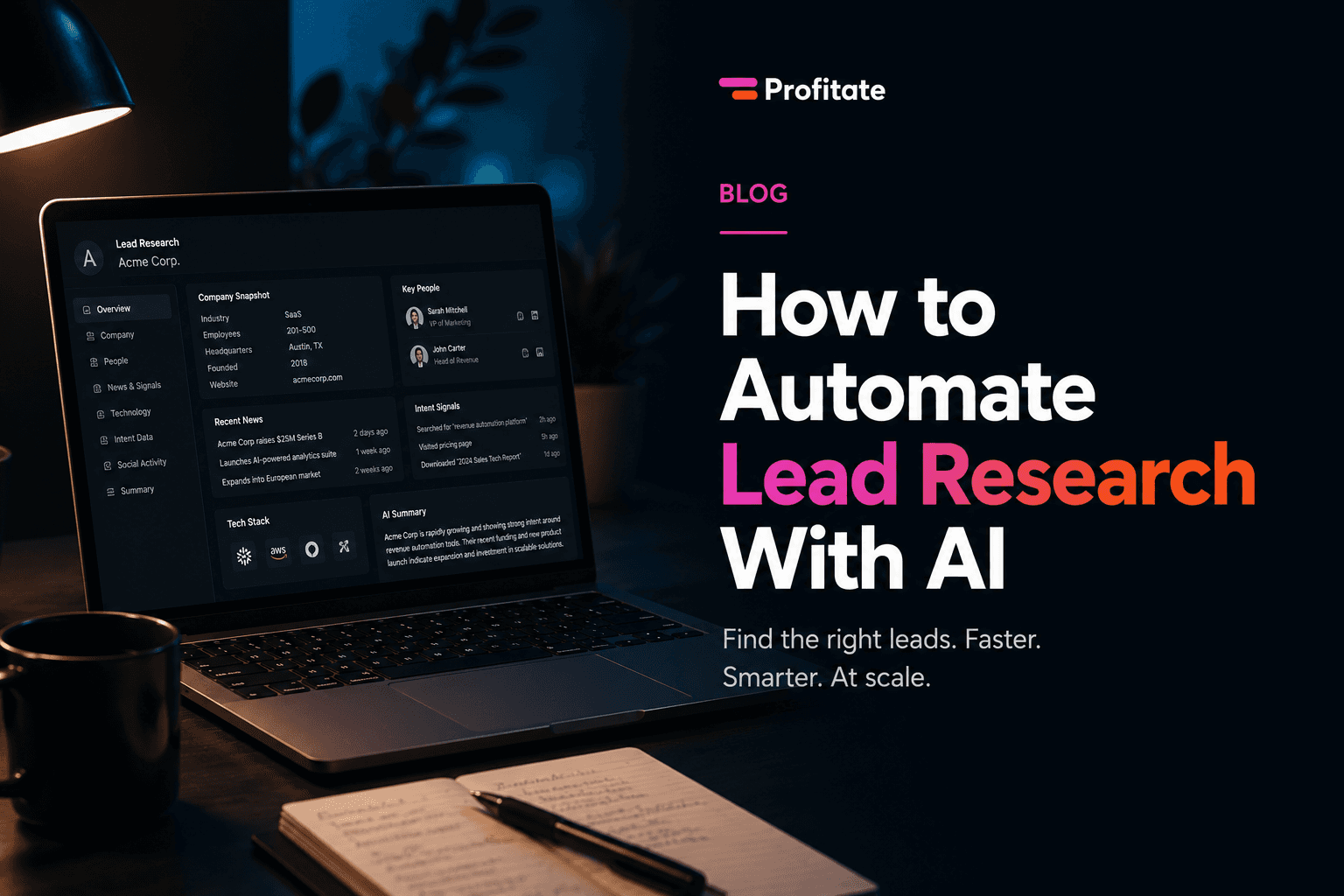
TL;DR: AI automates lead research by collecting company data, identifying buyer signals, enriching contact information, summarising account insights, and generating prospecting recommendations. Instead of manually researching every prospect, sales teams can use AI to identify high-potential accounts, understand why they may be ready to buy, and personalise outreach at scale.
What Is AI-Powered Lead Research?
AI-powered lead research is the process of using artificial intelligence to gather, analyse, and organise information about potential customers before outreach begins.
Traditionally, sales development representatives spend hours researching companies, reviewing LinkedIn profiles, analysing websites, identifying decision-makers, and looking for trigger events. AI automates much of this work by collecting data from multiple sources and turning it into actionable insights.
The result is faster prospecting, better personalisation, and more efficient outbound campaigns.
Why Should Sales Teams Automate Lead Research?
Manual lead research is often one of the most time-consuming parts of outbound sales. While research improves message quality, it limits the number of accounts a rep can realistically cover.
AI helps by reducing repetitive tasks while maintaining context and relevance.
Benefits include:
Faster prospect identification
More consistent account research
Better account prioritisation
Improved outreach personalisation
Higher sales productivity
Reduced administrative workload
More time spent speaking with prospects
The goal is not to eliminate research. The goal is to automate the collection and analysis of information so sales teams can focus on conversations.
What Information Can AI Research?
Modern AI systems can gather and organise large amounts of account intelligence.
Research Category | What AI Can Identify |
|---|---|
Company information | Industry, size, revenue, locations |
Buyer signals | Hiring, funding, expansion, leadership changes |
Website activity | Product interest, content engagement, pricing visits |
Technology stack | Software currently in use |
Contact information | Decision-makers and stakeholders |
Company news | Growth announcements and strategic changes |
LinkedIn activity | Hiring, promotions, company updates |
Competitive insights | Market positioning and alternatives |
The strongest research combines multiple data points to create a complete account profile.
How Does an AI Lead Research Workflow Operate?
Step 1: Define Your Ideal Customer Profile
AI works best when it knows what a good prospect looks like.
Define criteria such as:
Industry
Company size
Revenue range
Geography
Technology stack
Growth stage
Target job titles
This helps the AI focus on relevant accounts rather than collecting unnecessary data.
Step 2: Identify Buyer Signals
Once target accounts are identified, AI looks for signals that suggest a potential need.
Common signals include:
Funding announcements
Job postings
Leadership changes
Website visits
Product engagement
Technology adoption
LinkedIn activity
These signals help determine not only who to contact, but why now.
Step 3: Enrich Contact Data
AI can automatically identify relevant stakeholders within an account and enrich records with information such as:
Job titles
Department responsibilities
Seniority levels
Professional background
Contact details
This removes the need for manual prospect list building.
Step 4: Generate Research Summaries
Instead of reviewing dozens of websites and profiles, AI can create concise account summaries.
A typical summary may include:
Company overview
Recent growth indicators
Potential business challenges
Relevant buyer signals
Recommended outreach angles
Suggested decision-makers
This gives sales reps the context they need before initiating contact.
Step 5: Recommend Personalised Outreach
The final stage is turning research into action.
AI can generate messaging suggestions based on:
Account priorities
Industry trends
Hiring activity
Growth signals
Technology usage
Similar customer success stories
This creates more relevant outreach than generic cold prospecting.
What Makes AI Lead Research Effective?
The most effective systems combine three elements:
Accurate Data
AI is only as good as the information it receives. High-quality account, contact, and intent data are essential.
Relevant Buyer Signals
Research should focus on meaningful business events, not vanity metrics. Hiring, funding, expansion, leadership changes, and product engagement often provide stronger insights than basic company information.
Clear Sales Workflows
Research only creates value when it supports action. Every insight should help sales teams prioritise accounts, personalise messaging, or improve timing.
Common Mistakes When Automating Lead Research
Many companies automate data collection without improving decision-making.
Common mistakes include:
Researching accounts that do not fit the ICP
Collecting too much irrelevant information
Over-relying on AI-generated insights without verification
Prioritising volume over quality
Ignoring buyer signals and trigger events
Automating outreach without personalisation
The goal should be smarter prospecting, not simply faster prospecting.
Frequently Asked Questions
What is AI lead research?
AI lead research is the use of artificial intelligence to collect, analyse, and summarise prospect information, helping sales teams identify and prioritise potential buyers.
Can AI replace manual prospect research?
AI can automate much of the data gathering and analysis process, but human sales professionals still play an important role in judgement, relationship-building, and qualification.
What are the best signals for AI lead research?
The strongest signals include funding announcements, hiring activity, leadership changes, website engagement, technology adoption, and company expansion.
How much time can AI save in lead research?
Many sales teams reduce research time significantly by automating account analysis, contact enrichment, and signal monitoring, allowing reps to spend more time engaging with prospects and generating pipeline.