TL;DR: AI writes personalized cold emails by combining account data, buyer signals, company research, and proven messaging frameworks. Instead of simply inserting a prospect's name or company, modern AI systems identify why a prospect may need a solution now and generate outreach based on relevant business context.
What Does AI-Powered Email Personalization Mean?
AI-powered email personalization is the process of using artificial intelligence to create outbound messages tailored to a specific prospect, company, or business situation.
Traditional personalization often focuses on surface-level details such as company names, job titles, or recent LinkedIn posts. Modern AI personalization goes deeper by analysing buyer signals, company events, business priorities, and potential challenges.
The goal is to answer a prospect's most important question:
"Why is this relevant to me right now?"
When AI can answer that question effectively, cold emails become more engaging and more likely to receive a response.
How Does AI Gather Information for Personalized Emails?
Before generating an email, AI systems collect and analyse multiple data points about the account.
Common research inputs include:
Company size
Industry
Revenue stage
Hiring activity
Funding announcements
Leadership changes
Website engagement
Technology stack
LinkedIn activity
Existing CRM data
These inputs help AI understand both who the prospect is and what may be happening inside their business.
For example, a company hiring ten sales representatives presents a different opportunity than a company expanding internationally or replacing software systems.
How Does AI Turn Research Into Personalization?
The most effective AI systems follow a structured process.
Step | AI Action | Outcome |
|---|---|---|
Research | Collect company and contact information | Account context |
Signal detection | Identify hiring, funding, growth, or intent signals | Reason for outreach |
Pain point mapping | Connect signals to likely challenges | Relevant messaging angle |
Email generation | Create personalized copy | Prospect-specific email |
Quality review | Check tone and accuracy | Higher message quality |
The key is not the research itself. The key is connecting the research to a business problem the prospect may be trying to solve.
What Buyer Signals Create the Best Personalized Emails?
Strong personalization starts with strong signals.
Some of the most effective signals include:
Hiring Activity
A company hiring aggressively often faces onboarding, productivity, reporting, or scaling challenges.
Example angle:
"I noticed your team is expanding the sales organisation. Companies at this stage often focus on improving rep ramp time and pipeline visibility."
Funding Announcements
Funding often creates growth pressure and operational change.
Example angle:
"Following a recent funding round, many teams begin reviewing the systems needed to support faster growth."
Leadership Changes
New executives frequently reassess processes, vendors, and priorities.
Example angle:
"New revenue leaders often look for opportunities to improve forecasting, visibility, and execution during their first few months."
Website Engagement
Pricing page visits, product research, and content engagement can indicate active interest.
Example angle:
"Many teams evaluating this area are focused on improving efficiency without adding operational complexity."
What Does a Good AI-Personalized Cold Email Look Like?
Effective AI-generated emails follow a simple structure:
Relevant trigger or signal
Business hypothesis
Problem or challenge
Value proposition
Low-friction call to action
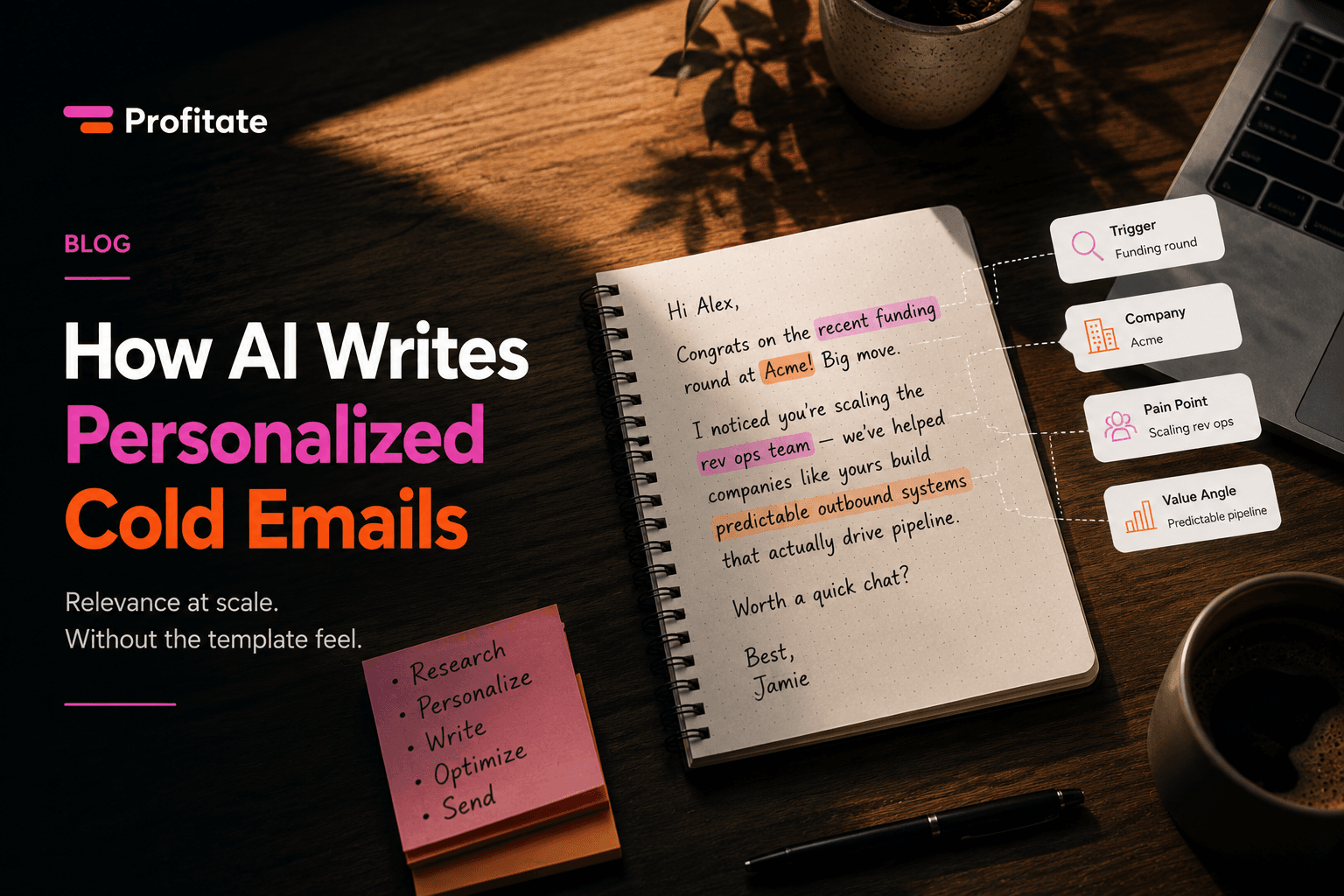
Example:
Hi Sarah,
I noticed your team is hiring several account executives after recent expansion announcements.
Companies at this stage often struggle with pipeline visibility and rep ramp time as sales teams grow.
We help revenue teams improve outbound efficiency and increase qualified pipeline without adding additional manual processes.
Would it be worth comparing how similar companies are approaching this challenge?
This email works because the personalization is tied to a business priority rather than a superficial observation.
Why Do Generic AI Emails Fail?
Many companies assume personalization means mentioning something they found online. In reality, prospects care far more about relevance than recognition.
Weak personalization:
"I saw your LinkedIn post and thought I'd reach out."
Strong personalization:
"Companies expanding their sales teams often face challenges maintaining outbound consistency and pipeline quality."
The second example focuses on a business problem rather than a personal observation.
What Makes AI Email Personalization Effective?
The best AI-generated cold emails share four characteristics:
Context
The email is based on a real buyer signal.
Relevance
The message connects directly to a likely business challenge.
Brevity
The email is concise and easy to understand.
Specificity
The outreach explains why the prospect may care now.
When these elements work together, personalization feels useful rather than automated.
Frequently Asked Questions
How does AI personalize cold emails?
AI personalizes cold emails by analysing account data, buyer signals, company research, and prospect information to generate relevant messaging.
What data does AI use to write personalized emails?
AI commonly uses hiring activity, funding announcements, company growth signals, website engagement, leadership changes, industry information, and CRM data.
Can AI write better cold emails than humans?
AI can often generate drafts faster than humans, but the best results usually come from combining AI-generated research and messaging with human review and strategic oversight.
What is the biggest mistake in AI email personalization?
The biggest mistake is focusing on surface-level personalization rather than business relevance. Mentioning a prospect's company or LinkedIn post is less effective than connecting outreach to a real business challenge or trigger event.