TL;DR: Trigger-based outreach works because it aligns sales messaging with a prospect’s current context, priorities, and mental availability. Instead of interrupting someone with a generic pitch, it uses a relevant business event—such as hiring, funding, leadership change, website activity, or expansion—to make the message feel timely, specific, and worth considering.
What Is Trigger-Based Outreach?
Trigger-based outreach is a sales approach that uses a recent event or buyer signal as the reason for contacting a prospect. The trigger gives the outreach context and explains why the message is being sent now.
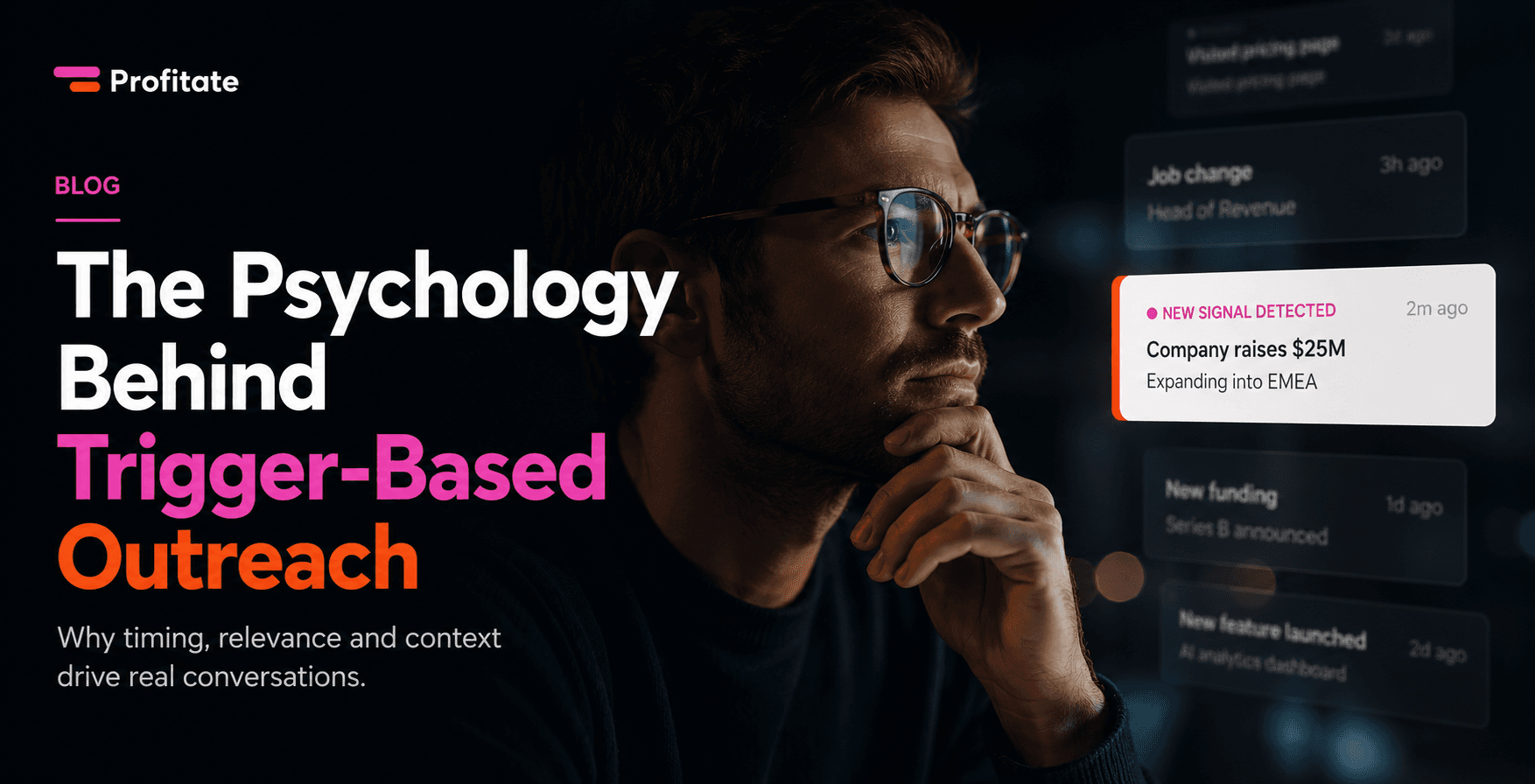
Common triggers include funding announcements, new executive hires, job postings, website visits, LinkedIn activity, technology changes, market expansion, or competitor research. These signals help sales teams move from “cold outreach” to “contextual outreach.”
The psychology is simple: people are more likely to respond when a message connects to something already on their mind.
Why Does Trigger-Based Outreach Work?
Trigger-based outreach works because it reduces the mental effort required to understand the message. A generic email forces the buyer to figure out why it matters. A trigger-based message makes the relevance obvious.
For example, a company hiring five sales development representatives may already be thinking about pipeline, onboarding, data quality, and sales productivity. A message connected to that hiring activity feels more relevant because it matches an active business priority.
This creates three psychological advantages:
Relevance: The message connects to a visible need.
Timing: The prospect has a current reason to care.
Specificity: The outreach feels researched, not automated.
What Psychological Principles Make Trigger-Based Outreach Effective?
Psychological Principle | How It Applies to Outreach |
|---|---|
Salience | Recent business events are more noticeable and easier to act on |
Cognitive ease | A relevant message is easier to understand quickly |
Loss aversion | Change creates risk, and buyers want to avoid costly mistakes |
Social proof | Similar-company examples make the message feel safer |
Reciprocity | Useful insight makes the prospect more open to responding |
Pattern recognition | Buyers recognise problems that match their current situation |
The strongest outreach does not manipulate these principles. It uses them to make the message clearer, more helpful, and more aligned with the buyer’s real situation.
How Do Triggers Create Urgency?
Triggers create urgency because they often signal change. When a company raises funding, hires a new leader, expands a team, or changes technology, the business is entering a moment where old systems may no longer be enough.
Change creates pressure. Teams need to move faster, avoid mistakes, reduce risk, and prove results. Trigger-based outreach works when it connects your solution to that pressure in a practical way.
For example, a new CRO may be reviewing sales processes. A company expanding internationally may need better compliance, payroll, or operational systems. A business hiring engineers may need improved infrastructure or development workflows.
What Makes a Trigger Feel Relevant Instead of Opportunistic?
A trigger feels relevant when the outreach focuses on the prospect’s likely business problem, not the trigger itself. Weak outreach says, “Congratulations on your funding.” Strong outreach explains what the funding may mean and how similar companies handle the next stage.
A useful message should include:
The trigger
The likely business priority
The pain point created by that priority
A clear outcome your solution supports
A low-friction next step
Example:
“I saw your team is hiring several account executives after the recent funding round. Companies at this stage often need better pipeline visibility and faster rep ramp time. We help growing sales teams improve outbound execution without adding extra admin.”
What Mistakes Should Sales Teams Avoid?
The biggest mistake is using triggers as surface-level personalisation. Mentioning a funding round, job post, or LinkedIn update is not enough. The message still needs a strong business reason.
Avoid outreach that feels like surveillance. Do not over-reference exact page visits, profile views, or personal activity. Use the signal to guide the message, not to make the prospect feel watched.
Trigger-based outreach works best when it feels informed, respectful, and commercially useful.
Frequently Asked Questions
What is the main psychology behind trigger-based outreach?
The main psychology is relevance. Buyers are more likely to engage when a message connects to a current business priority, recent change, or problem they are already thinking about.
Are triggers the same as personalisation?
No. Triggers explain why now. Personalisation explains why this prospect. The best outbound messages use both.
What is the best trigger for outbound sales?
The best trigger depends on your product, but strong triggers often include funding, hiring, leadership changes, website engagement, competitor research, and technology changes.
Why do generic outbound messages fail?
Generic messages fail because they require too much interpretation from the buyer. They do not clearly explain why the message matters, why it matters now, or what problem it helps solve.