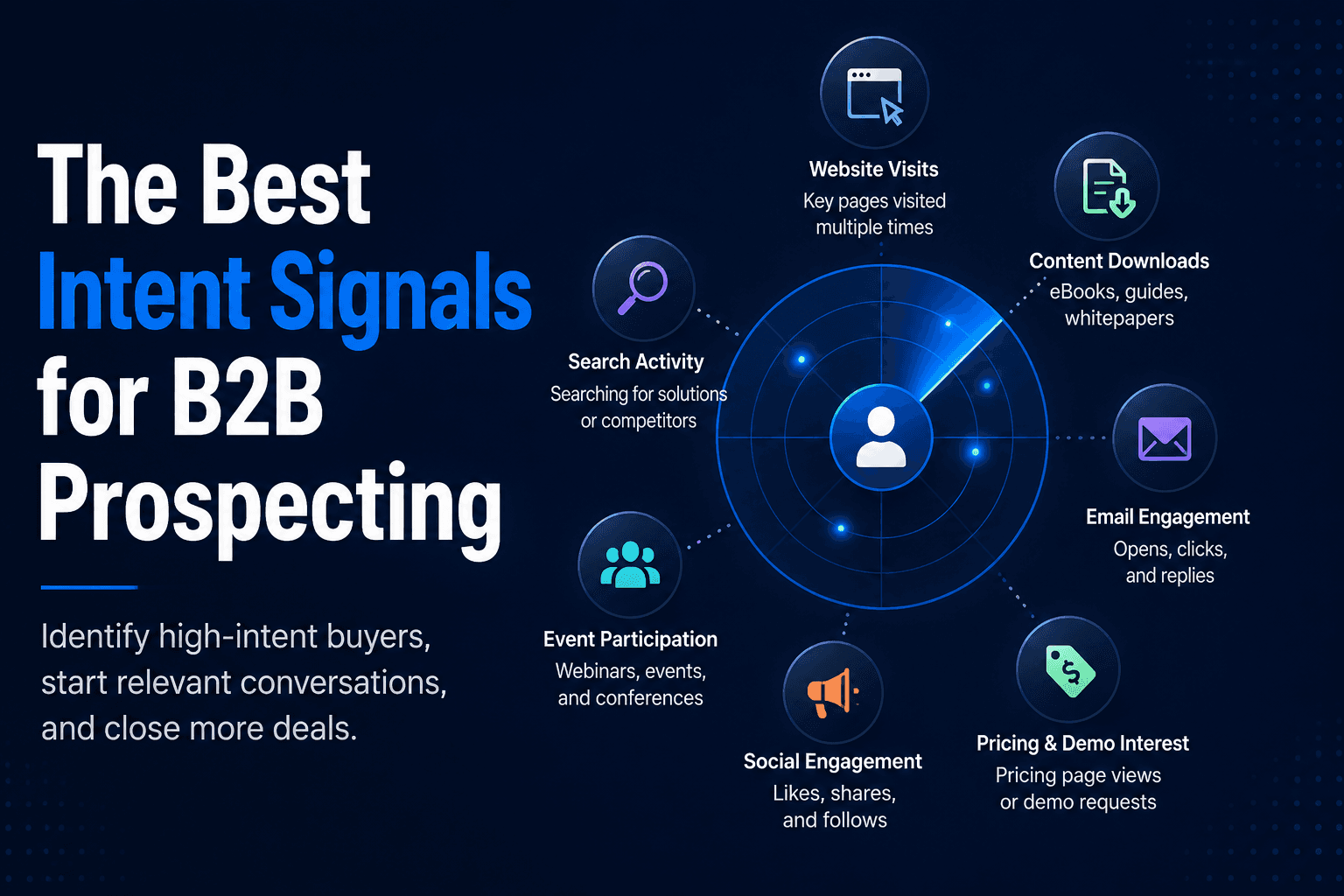
TL;DR: The best intent signals for B2B prospecting are buying-trigger events, website engagement, product research behaviour, hiring activity, technology changes, funding announcements, competitor comparisons, and content consumption patterns. The strongest prospecting signals show that a company has a current business problem, budget potential, decision urgency, and a reason to speak with your sales team now.
What Are Intent Signals in B2B Prospecting?
B2B intent signals are behaviours or events that suggest a company may be actively researching, evaluating, or preparing to buy a product or service. These signals help sales teams prioritise prospects based on real buying likelihood rather than static firmographic data alone.
A strong intent signal answers one key question: why would this company care about our solution right now? The more recent, specific, and problem-linked the signal is, the more useful it becomes for outbound sales.
Why Do Intent Signals Matter for B2B Sales?
Intent signals improve prospecting because they help sales teams contact the right companies at the right time with a more relevant message. Instead of relying only on industry, company size, or job title, sales teams can identify accounts showing active need.
Intent-led prospecting usually leads to:
Higher reply rates
Better account prioritisation
More relevant outreach
Shorter qualification cycles
Less wasted sales activity
Stronger alignment between sales and marketing
The goal is not simply to find companies that match your ideal customer profile. The goal is to find companies that match your ideal customer profile and show evidence of current demand.
What Are the Best Intent Signals for B2B Prospecting?
1. Website Visits and High-Intent Page Views
A prospect visiting your website is one of the clearest first-party intent signals. Pages such as pricing, case studies, product comparisons, demo requests, integrations, and implementation guides often show stronger buying interest than general blog traffic.
For example, a visitor reading “how it works” may be learning. A visitor viewing pricing, security documentation, and customer success stories may be evaluating.
2. Content Engagement
Content engagement shows what problems a prospect is trying to understand. Downloads, webinar attendance, newsletter clicks, guide views, and repeated visits to topic-specific pages can reveal active research intent.
The strongest content signals are problem-specific. A CFO reading an article about reducing software waste, for example, is a better signal for spend-management vendors than a generic visit to a homepage.
3. Funding, Growth, and Expansion Announcements
Funding rounds, new office openings, international expansion, leadership hires, and rapid headcount growth often create new buying needs. These events suggest budget movement, operational change, or pressure to scale.
A company that has just raised capital may invest in sales tools, finance systems, recruitment software, security platforms, or infrastructure upgrades.
4. Hiring Activity
Job postings are powerful intent signals because they reveal business priorities. A company hiring multiple data engineers may need analytics infrastructure. A company hiring outbound sales representatives may need CRM, enrichment, dialling, or enablement tools.
Hiring intent is especially useful because it reflects planned investment, not just interest.
5. Technology Changes
Technology signals show what tools a company currently uses, has added, or may be replacing. New software adoption can create integration opportunities, while outdated or overlapping tools can suggest replacement potential.
For example, if a company recently adopted Salesforce, they may also need enrichment, routing, attribution, or sales engagement software.
6. Competitor and Comparison Research
When prospects search for alternatives, reviews, pricing comparisons, or “best software for” queries, they are often close to vendor evaluation. These signals are valuable because they suggest the buyer is no longer just problem-aware; they may be solution-aware.
Sales teams should treat competitor comparison behaviour as a high-priority signal, especially when combined with visits to pricing or demo pages.
7. Regulatory, Market, or Operational Change
External pressure can create urgent buying intent. New regulations, compliance requirements, market disruption, cost-cutting initiatives, supply chain issues, or security risks can all push companies to search for solutions.
These signals are especially useful for legal, cybersecurity, finance, HR, insurance, and compliance-related B2B products.
How Should Sales Teams Prioritise Intent Signals?
The best approach is to score intent signals based on recency, relevance, source, and strength.
Intent Signal | Strength | Why It Matters |
|---|---|---|
Pricing page visit | High | Shows commercial evaluation |
Demo request | Very high | Indicates direct buying interest |
Funding announcement | Medium to high | Suggests new budget or growth |
Hiring activity | Medium | Reveals operational priorities |
Competitor comparison | High | Shows vendor evaluation |
Blog visit | Low to medium | Indicates early research |
Technology adoption | Medium to high | Creates integration or replacement need |
What Makes an Intent Signal Strong?
A strong B2B intent signal is recent, repeated, relevant, and connected to a business pain. One signal may be interesting, but multiple signals together create a stronger buying hypothesis.
For example, a company hiring sales reps, visiting your CRM integration page, and reading sales productivity content is showing a clearer pattern than a company that only opened one email.
Frequently Asked Questions
What is the most reliable B2B intent signal?
The most reliable B2B intent signal is direct first-party engagement, such as a demo request, pricing page visit, or repeated visits to product-specific pages. These actions happen on your owned channels and usually indicate active evaluation.
Are third-party intent signals useful?
Third-party intent signals are useful when they show account-level research patterns across external websites. However, they are strongest when combined with first-party data, firmographics, and sales context.
How do you use intent signals in outbound sales?
Use intent signals to personalise outreach. Reference the likely business trigger, connect it to a specific pain point, and offer a relevant next step. The signal should guide the message, not become the entire pitch.
What is the main mistake companies make with intent data?
The main mistake is treating every signal equally. A single blog visit is not the same as repeated pricing-page activity, competitor research, or a major hiring push. Intent data works best when signals are ranked by buying relevance.