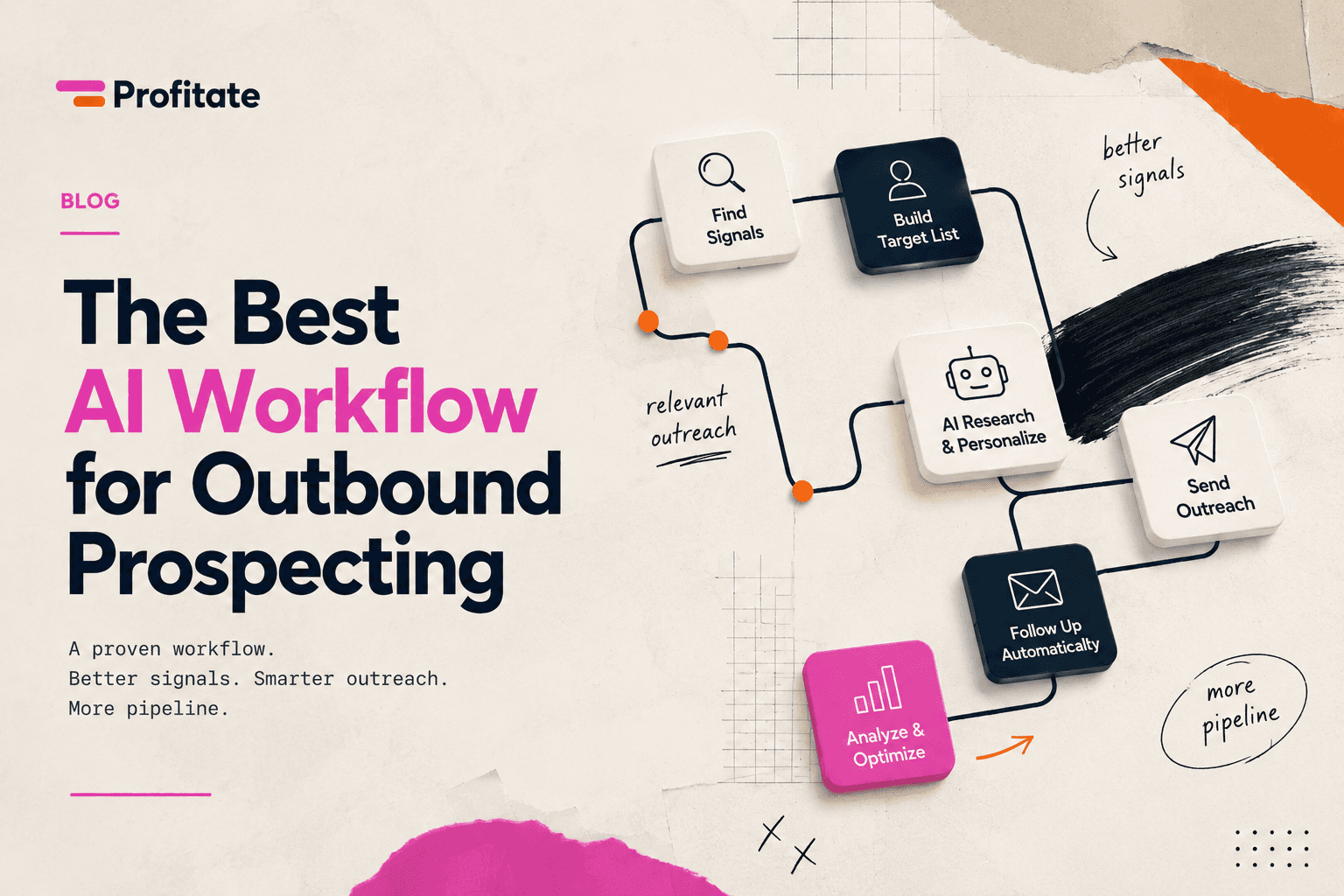
TL;DR: The best AI workflow for outbound prospecting combines ideal customer profile (ICP) targeting, buyer signal detection, account research, contact enrichment, AI-generated messaging, automated sequencing, and human qualification. The goal is not to automate more outreach. The goal is to identify the right prospects at the right time with the right message.
What Is an AI Outbound Prospecting Workflow?
An AI outbound prospecting workflow is a structured process that uses artificial intelligence to identify, research, prioritise, and engage potential customers.
Traditional outbound often relies on static prospect lists and generic messaging. AI-driven outbound uses real-time data and buyer signals to determine who is most likely to buy and why they may be receptive to a conversation today.
The most effective workflows combine automation with human oversight, allowing sales teams to scale prospecting without sacrificing relevance.
Why Are AI Workflows More Effective Than Traditional Outbound?
AI improves outbound prospecting because it helps sales teams focus on opportunities that are more likely to convert.
Instead of manually researching hundreds of companies, AI can automatically identify:
High-fit accounts
Active buyer signals
Relevant decision-makers
Business priorities
Potential pain points
Personalisation opportunities
This allows sales representatives to spend more time having conversations and less time gathering information.
What Does the Best AI Outbound Workflow Look Like?
Step 1: Define Your Ideal Customer Profile
Every successful workflow starts with a clear ICP.
Your AI system should understand:
Industry
Company size
Revenue range
Geography
Technology stack
Growth stage
Target decision-makers
Without a clear ICP, even the most advanced AI will target the wrong accounts.
Step 2: Monitor Buyer Signals
Once target accounts are identified, AI should continuously monitor for buying signals.
High-value signals include:
Hiring activity
Funding announcements
Leadership changes
Website visits
Product page engagement
LinkedIn activity
Technology adoption
Expansion announcements
Competitor research
These signals answer the most important outbound question:
Why should we contact this company now?
Which Signals Produce the Best Results?
Buyer Signal | Why It Matters |
|---|---|
Funding announcement | Indicates budget and growth plans |
Hiring activity | Reveals strategic priorities |
Website engagement | Shows active interest |
Leadership changes | Often trigger vendor reviews |
Technology changes | Create replacement opportunities |
LinkedIn activity | Provides business context |
Competitor research | Signals evaluation behaviour |
The strongest opportunities usually involve multiple signals occurring simultaneously.
Step 3: Automate Account Research
Once signals are detected, AI should automatically research the account.
Research should include:
Company overview
Recent announcements
Hiring trends
Growth indicators
Technology stack
Strategic priorities
Potential challenges
The output should be a concise account summary that helps sales teams understand the business quickly.
Step 4: Enrich Decision-Maker Data
AI can identify and enrich the most relevant contacts within each account.
Common target personas include:
Founders
CEOs
CROs
VPs of Sales
Marketing leaders
Operations executives
IT decision-makers
The objective is to connect the buyer signal to the person most likely to care about solving the problem.
Step 5: Generate Personalised Outreach
AI should then create messaging based on the account's situation rather than generic personalisation.
A strong message includes:
Relevant signal
Business hypothesis
Potential challenge
Value proposition
Clear call to action
Example:
I noticed your team is hiring several account executives following your recent expansion.
Companies at this stage often focus on improving pipeline visibility and onboarding efficiency.
We help growing sales organisations increase rep productivity without adding operational complexity.
This approach feels relevant because it is based on a real business event.
Step 6: Execute Multi-Channel Sequences
The best AI workflows do not rely on a single channel.
Outbound sequences typically include:
Email
LinkedIn
Phone calls
Video messages
Social engagement
AI can automate timing, follow-ups, and channel coordination while adapting based on prospect engagement.
Step 7: Qualify and Route Responses
After outreach begins, AI should classify incoming responses.
Common categories include:
Interested
Referral
Objection
Not now
Unsubscribe
Positive responses should be routed immediately to the appropriate sales representative.
This ensures qualified opportunities receive timely follow-up.
Step 8: Continuously Optimise Performance
The final stage is measurement and optimisation.
Key metrics include:
Metric | Why It Matters |
|---|---|
Positive reply rate | Measures message relevance |
Meeting conversion rate | Evaluates qualification quality |
Pipeline generated | Measures commercial impact |
Account engagement | Tracks buying activity |
Signal-to-meeting ratio | Identifies valuable triggers |
Opportunity creation rate | Connects outreach to revenue |
The best AI workflows improve continuously as more engagement data becomes available.
What Makes an AI Prospecting Workflow Successful?
The most successful AI prospecting workflows focus on precision rather than volume.
They combine:
Strong ICP targeting
Reliable buyer signals
Accurate data enrichment
Contextual personalisation
Automated execution
Human judgement
AI should help sales teams identify opportunities faster, not simply send more messages.
Frequently Asked Questions
What is an AI outbound prospecting workflow?
An AI outbound prospecting workflow is a system that uses artificial intelligence to identify prospects, analyse buyer signals, personalise outreach, automate follow-up, and route qualified opportunities to sales teams.
What is the most important part of AI prospecting?
The most important component is signal detection. Without relevant buyer signals, even highly personalised outreach can lack timing and urgency.
Can AI automate the entire outbound process?
AI can automate large parts of prospecting, research, enrichment, sequencing, and response classification. However, human involvement remains valuable for strategy, qualification, and relationship-building.
What are the best buyer signals for AI outbound?
The strongest signals include funding announcements, hiring activity, leadership changes, website engagement, technology adoption, LinkedIn activity, and competitor evaluation behaviour.