
TL;DR: Dynamic Value Propositions (DVPs) adapt your core message based on persona, industry, trigger, and context. Instead of sending one generic pitch to everyone, the value proposition changes depending on who the recipient is and why you’re contacting them. The result: sharper relevance, stronger positioning, and higher engagement.
What Are Dynamic Value Propositions?
A Dynamic Value Proposition takes your base value proposition and modifies it automatically based on contextual inputs.
Instead of rewriting entire emails, you adjust the core value framing depending on:
Persona (e.g. Sales Leader vs Founder)
Industry (e.g. B2B SaaS vs Recruitment)
Trigger event (e.g. hiring push, funding round)
Company size
Product line being positioned
Public signals (e.g. LinkedIn bio)
The offer stays the same. The framing changes.
This removes generic messaging while maintaining clarity and scale.
Why Generic Value Propositions Don’t Work
Most outbound fails at the positioning layer.
Companies send the same value proposition to:
A founder focused on growth
A VP of Sales focused on pipeline
A recruiter focused on placements
Even if the product is relevant, the framing isn’t.
A generic value proposition forces the reader to translate it into their world. Most won’t bother.
Dynamic Value Propositions remove that cognitive friction.
How We Use Dynamic Value Propositions at Profitate
We recently launched Dynamic Value Propositions and immediately implemented them in our own outreach.
Here’s how.
1. Persona-Based Value Propositions
We adjust messaging depending on who we’re speaking to.
Sales Leader Version
Focus: Pipeline, rep productivity, revenue targets. Framing: Book more qualified meetings without increasing headcount.
Founder Version
Focus: Growth, capital efficiency, leverage. Framing: Predictable pipeline without building an outbound team internally.
Same product. Different pressure points.
Persona-level framing increases message resonance because it aligns with job-to-be-done priorities.
2. Industry-Based Value Propositions
We also tailor based on segment.
For Profitate, our two core segments are:
B2B businesses
Recruitment agencies
B2B SaaS
Positioning centers on scaling outbound and accelerating sales cycles.
Recruitment Agencies
Positioning focuses on candidate/client acquisition efficiency and consultant productivity.
The mechanics of the product don’t change. The use case emphasis does.
Industry context improves clarity instantly.
3. Trigger-Based Value Propositions
This is where Dynamic Value Propositions become powerful.
If an email is triggered by:
A funding round
A hiring push
A new market expansion
A product launch
The value proposition shifts to reflect that specific moment.
For example:
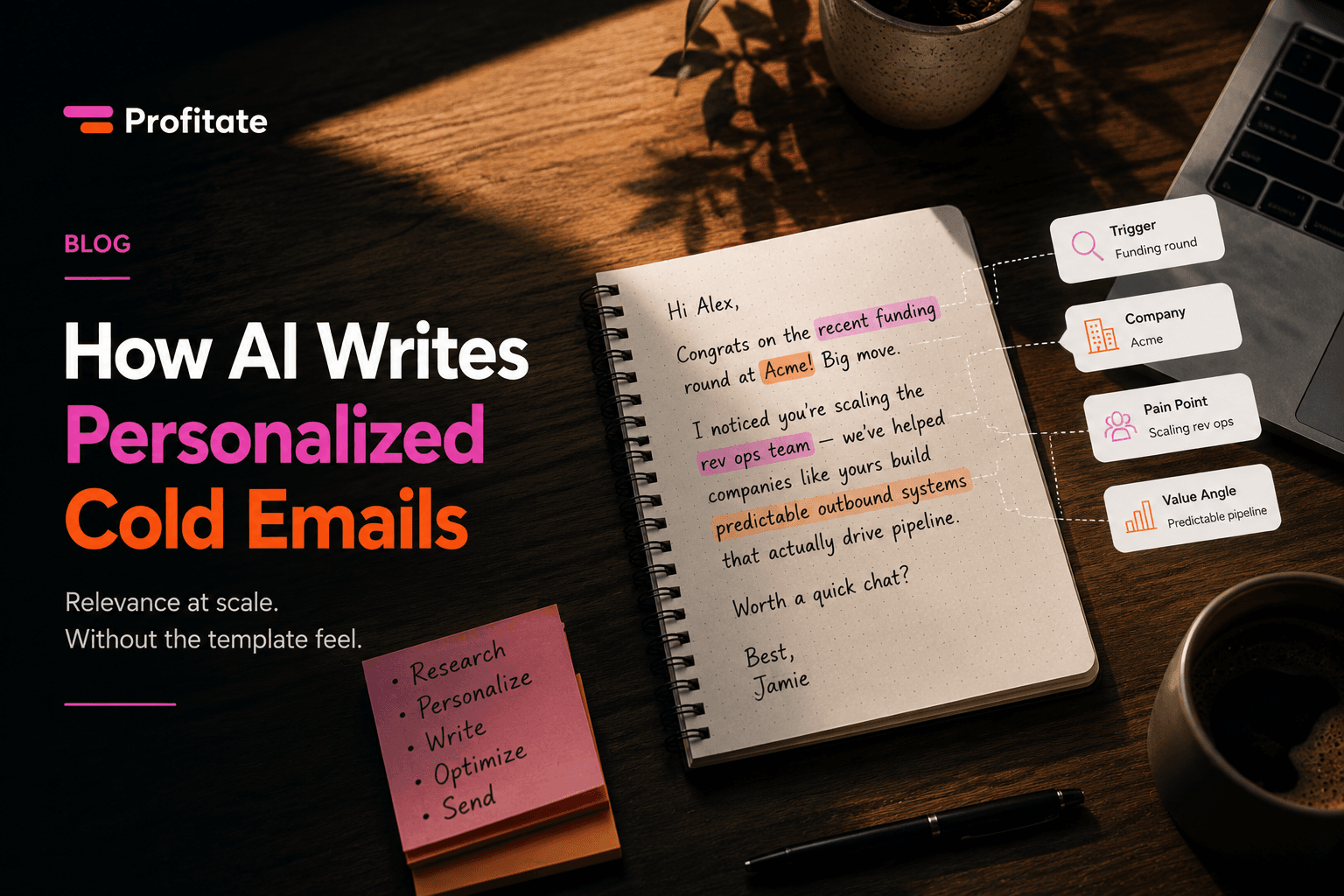
Funding Trigger: “Scale pipeline faster post-Series A.”
Hiring Trigger: “Support new AEs with qualified meetings from day one.”
The message mirrors the reason for outreach.
That alignment drives relevance.
4. LinkedIn Bio-Based Adjustments (With Caution)
We can also tailor value propositions based on LinkedIn bios.
For example:
If someone mentions “RevOps” → emphasize process efficiency.
If someone mentions “Go-to-market” → emphasize scalable acquisition.
However, this signal is less reliable. Bios are not always updated.
It works best as a secondary input, not a primary driver.
5. Other Dynamic Inputs We Use
Dynamic Value Propositions can also adjust based on:
Company size (startup vs enterprise)
Geography (local language variants like Aussie vs American English)
Specific product positioning
Growth stage
Team structure
Each variable changes emphasis — not the entire pitch.
Small shifts in framing create large shifts in perceived relevance.
Dynamic vs Static Value Propositions
Static Messaging | Dynamic Messaging |
|---|---|
One-size-fits-all | Persona-specific |
Same framing for every industry | Industry-aligned positioning |
Ignores timing | Trigger-based framing |
Generic benefits | Contextual outcomes |
Feels templated | Feels intentional |
The difference is subtle but significant.
The Core Principle: No More Generic Value Propositions
AI personalization alone isn’t enough.
True relevance happens at the value layer.
Dynamic Value Propositions ensure your message adapts to:
Who the recipient is
What they care about
What just happened
What stage they’re at
The result isn’t longer emails.
It’s sharper positioning.
And sharper positioning converts.