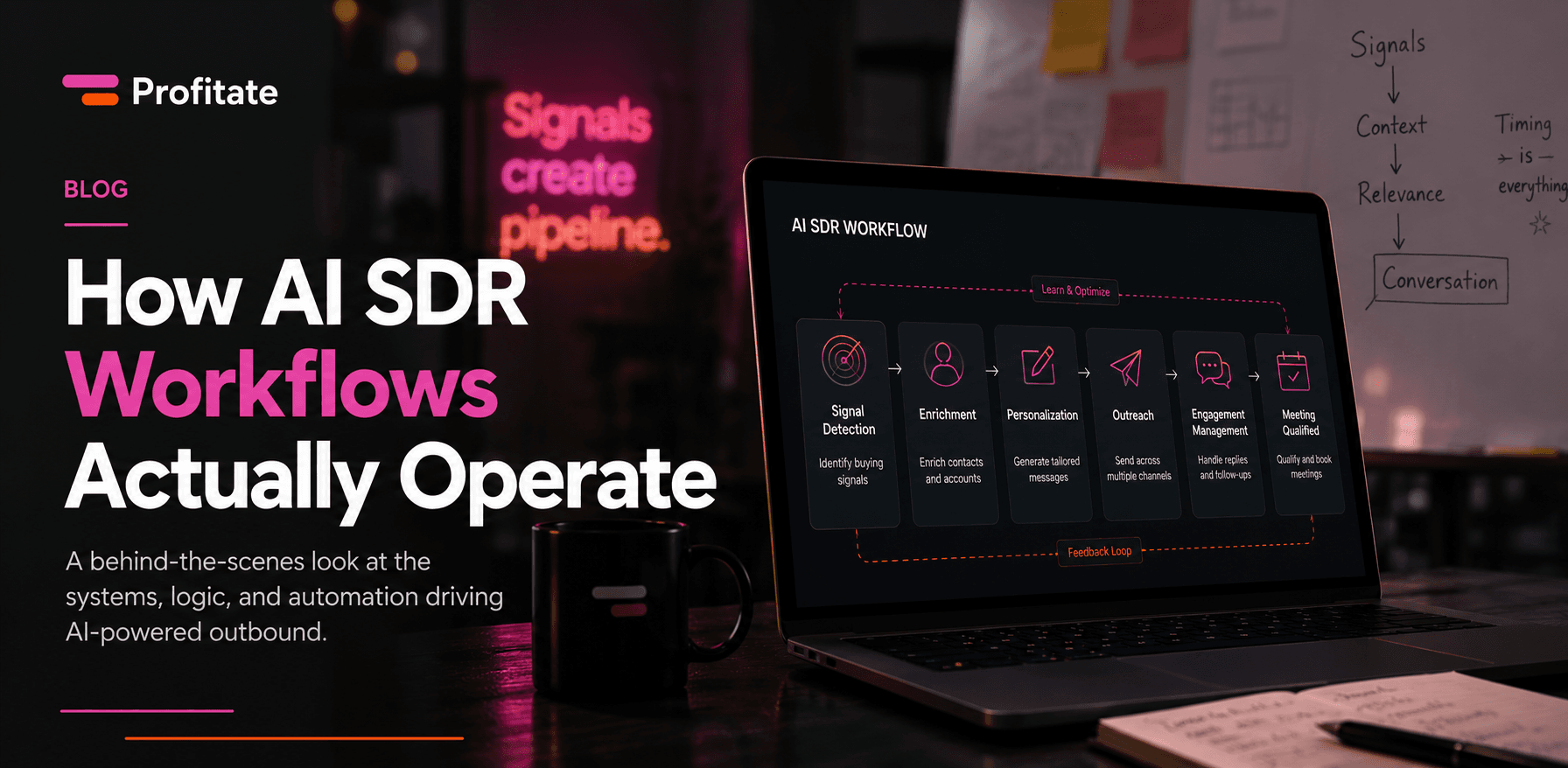
TL;DR: AI SDR workflows operate by combining buyer signals, account data, enrichment, automated research, message generation, sequencing, reply handling, and human approval. The best systems do not simply “send automated emails.” They identify the right accounts, understand why now is a good time to reach out, create relevant messaging, and route high-intent replies to salespeople.
What Is an AI SDR Workflow?
An AI SDR workflow is a structured outbound sales process where artificial intelligence handles parts of prospecting, research, personalisation, follow-up, and qualification. Instead of manually building lists and writing every email, sales teams use AI to turn account signals into targeted outbound campaigns.
A strong AI SDR workflow still needs strategy, data quality, and human oversight. AI can improve speed and relevance, but it works best when it follows clear rules about who to contact, what signals matter, and when a human should step in.
How Does an AI SDR Workflow Start?
An AI SDR workflow usually starts with account selection. The system identifies companies that match the ideal customer profile based on industry, company size, location, revenue stage, technology stack, hiring activity, funding, or website behaviour.
The AI then looks for a reason to contact each account. This reason is usually called a trigger or buyer signal. Common examples include a new funding round, a leadership hire, a job posting, a pricing page visit, a LinkedIn update, or recent technology adoption.
The goal is to answer one question before outreach begins: why would this company care right now?
What Steps Happen Inside an AI SDR Workflow?
Workflow Step | What the AI Does | Why It Matters |
|---|---|---|
Account targeting | Finds companies matching your ICP | Prevents irrelevant outreach |
Signal detection | Tracks hiring, funding, visits, or changes | Creates timing and context |
Contact enrichment | Finds relevant decision-makers | Improves targeting accuracy |
Research summarisation | Extracts useful company context | Supports personalisation |
Message generation | Drafts emails or LinkedIn messages | Speeds up campaign creation |
Sequence execution | Sends follow-ups based on rules | Keeps outreach consistent |
Reply classification | Identifies interest, objections, or opt-outs | Protects sales time |
Human handoff | Routes qualified replies to reps | Keeps buyers moving |
How Does AI Personalise Outbound Messages?
AI personalises outbound by connecting a buyer signal to a likely business problem. Weak AI personalisation simply inserts a company name, industry, or job title. Strong AI personalisation explains what is happening at the account and why that creates a relevant need.
For example, if a company is hiring multiple account executives after raising funding, the AI may generate a message about pipeline visibility, rep ramp time, onboarding, or outbound consistency. The signal becomes the reason for the message, not just a decorative opening line.
What Happens After the First Message Is Sent?
After the first message, the AI SDR monitors engagement and adjusts the workflow. It may send follow-ups, pause outreach after a reply, classify objections, update CRM fields, notify the account owner, or book meetings through a scheduling link.
The best workflows avoid treating every prospect the same. A prospect who clicks a case study, replies with interest, and visits a demo page should be prioritised differently from someone who never engages.
Where Should Humans Stay Involved?
Humans should stay involved in strategy, offer positioning, approval rules, objection handling, and high-value conversations. AI can automate repetitive work, but humans should control the message quality, targeting logic, compliance standards, and final sales conversation.
A practical model is human-led, AI-assisted outbound. AI handles research and execution at scale, while salespeople focus on judgement, relationship-building, qualification, and closing.
What Makes an AI SDR Workflow Effective?
An effective AI SDR workflow is built on clean data, specific triggers, strong ICP rules, useful messaging, and clear handoff points. The system should not optimise for sending more messages. It should optimise for reaching better-fit accounts at better moments with more relevant context.
The strongest workflows combine automation with restraint. They use AI to increase precision, not just volume.
Frequently Asked Questions
What does an AI SDR do?
An AI SDR helps automate outbound sales tasks such as account research, contact enrichment, message drafting, follow-up sequencing, reply classification, and meeting routing.
Can AI SDRs replace human SDRs?
AI SDRs can replace some repetitive tasks, but they should not replace human judgement. Human SDRs are still important for strategy, nuanced conversations, qualification, and relationship-building.
What data does an AI SDR need?
An AI SDR needs account data, contact data, buyer signals, CRM history, messaging rules, ideal customer profile criteria, and clear instructions for when to escalate to a human.
What is the biggest mistake with AI SDR workflows?
The biggest mistake is using AI to send generic outreach at higher volume. AI SDR workflows work best when they improve relevance, timing, and account prioritisation.